using UnfoldDecode
using UnfoldSim
using UnfoldMakie
using CairoMakie
using Unfold
Overlap-corrected decoding tutorial
This approach follows the work of the Deoulle Group, especially Gal Vishne's work as published 2023: https://doi.org/10.1101/2023.06.28.546397
Simulation
We start with simulating some continuous, overlapping data with two conditions. As of now, UnfoldSim doesnt support multichannel, so we simply repeat the channel and add some noise`
dat, evt = UnfoldSim.predef_eeg()
dat = repeat(dat', 5)
dat .= dat .+ 20 .* rand(size(dat)...)
5×120198 Matrix{Float64}:
10.5108 0.416251 17.0277 14.8866 … 9.5131 7.66268 5.75951
2.91731 15.7109 3.70389 16.0292 13.2554 10.2967 15.7648
18.769 16.2931 11.1187 3.31247 14.9474 9.53028 15.7754
3.6189 16.6635 11.5203 4.30642 13.0098 11.2412 12.1376
13.0616 6.30699 2.30865 12.1063 6.78738 13.6806 3.93663Overlap-model Definition
We have to define what model we want to use for overlap correction We decide for a one-basisfunction model, with one one condition and one covariate, from -0.1 to 0.5 seconds afte the stimulus onset. Sampling rate 100 as in the simulation
des = [Any => (@formula(0 ~ 1 + condition + continuous), firbasis((-0.1, 1.0), 100))];Fitting and visualizing a single channel of the model
uf = Unfold.fit(UnfoldModel, des, evt, dat[1, :]);
plot_erp(coeftable(uf))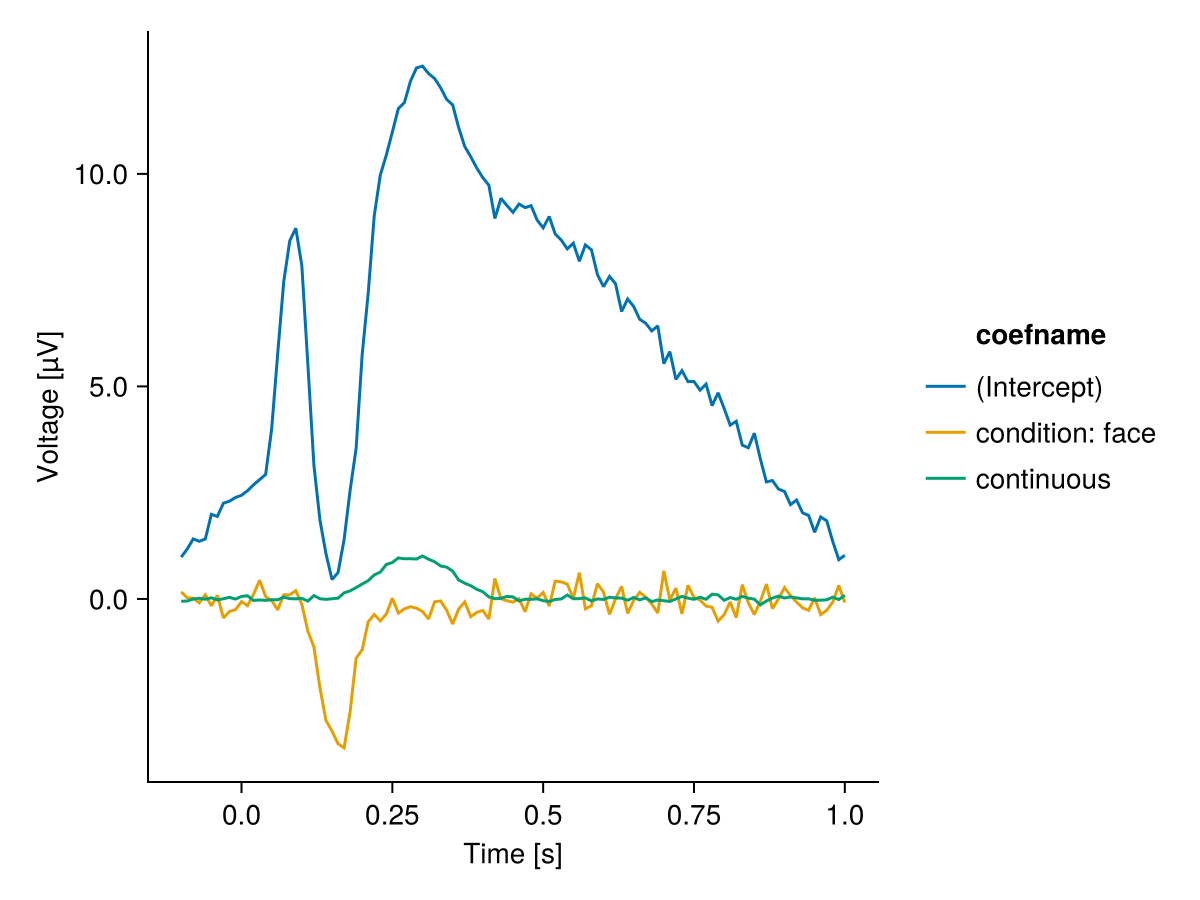
Fitting the Overlap-corrected LDA model
Following the MLJ Modelzoo we have to do the following to load an LDA model
using MLJ, MultivariateStats, MLJMultivariateStatsInterface
LDA = @load LDA pkg = MultivariateStats
uf_lda =
    Unfold.fit(UnfoldDecodingModel, des, evt, dat, LDA(), Any => :condition; nfolds = 2) # 2 folds to speed up computation
plot_erp(coeftable(uf_lda); mapping = (; color = :coefname))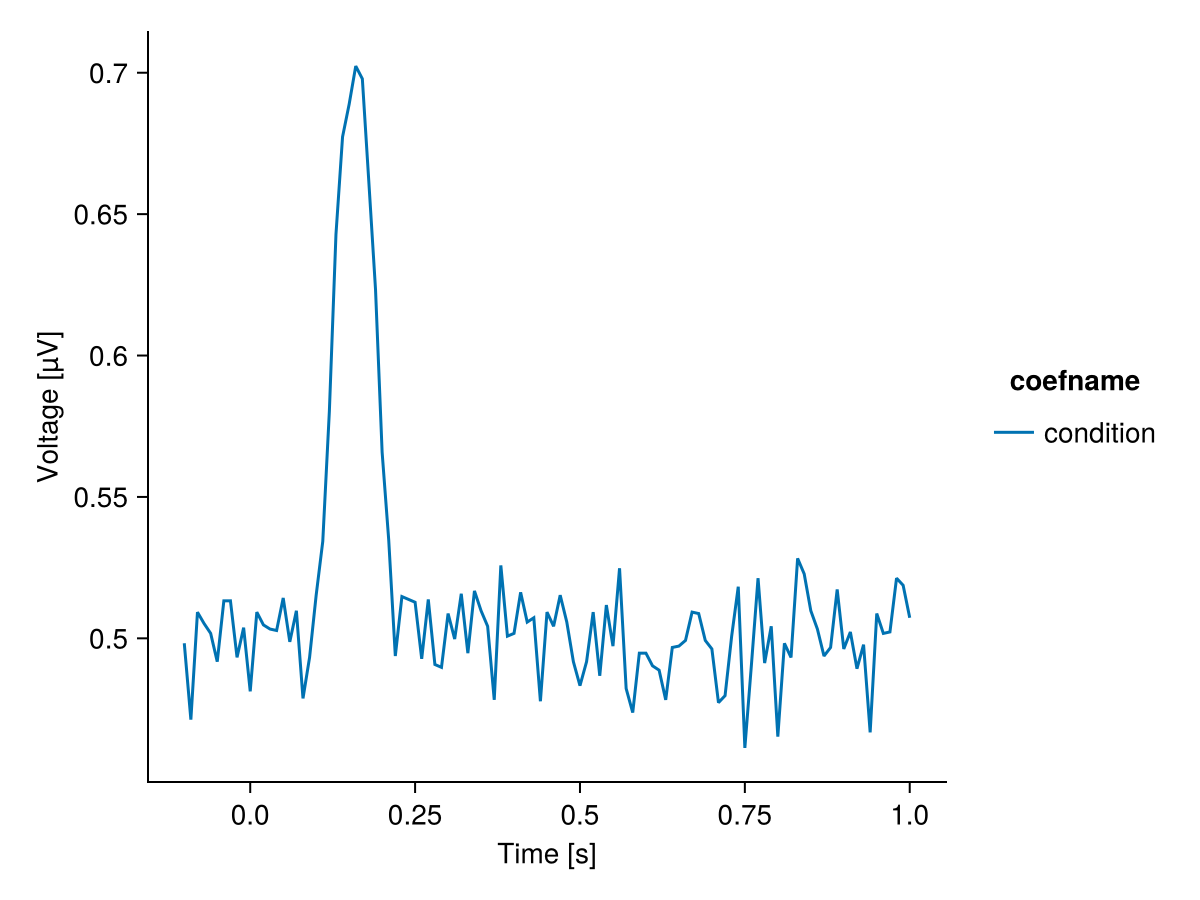
Voila, the model classified the correct period.
This page was generated using Literate.jl.