using UnfoldDecode
using UnfoldSim
using UnfoldMakie
using CairoMakie
using Unfold
Overlap-corrected decoding tutorial
This approach follows the work of the Deoulle Group, especially Gal Vishne's work as published 2023: https://doi.org/10.1101/2023.06.28.546397
Simulation
We start with simulating some continuous, overlapping data with two conditions. As of now, UnfoldSim doesnt support multichannel, so we simply repeat the channel and add some noise`
dat, evt = UnfoldSim.predef_eeg()
dat = repeat(dat', 5)
dat .= dat .+ 20 .* rand(size(dat)...)
5×120198 Matrix{Float64}:
19.6978 8.08767 17.5638 10.439 … 2.50607 19.0596 7.92488
7.74462 11.8711 0.705633 9.7881 2.01985 14.5811 17.9742
17.6398 10.8858 8.01589 20.4422 12.8524 4.91621 2.81294
13.6465 5.13836 17.2836 9.74502 17.3885 14.3746 5.55592
10.8251 19.7006 2.04726 17.3634 15.6874 0.371633 2.65462Overlap-model Definition
We have to define what model we want to use for overlap correction We decide for a one-basisfunction model, with one one condition and one covariate, from -0.1 to 0.5 seconds afte the stimulus onset. Sampling rate 100 as in the simulation
des = [Any => (@formula(0 ~ 1 + condition + continuous), firbasis((-0.1, 1.0), 100))];Fitting and visualizing a single channel of the model
uf = Unfold.fit(UnfoldModel, des, evt, dat[1, :]);
plot_erp(coeftable(uf))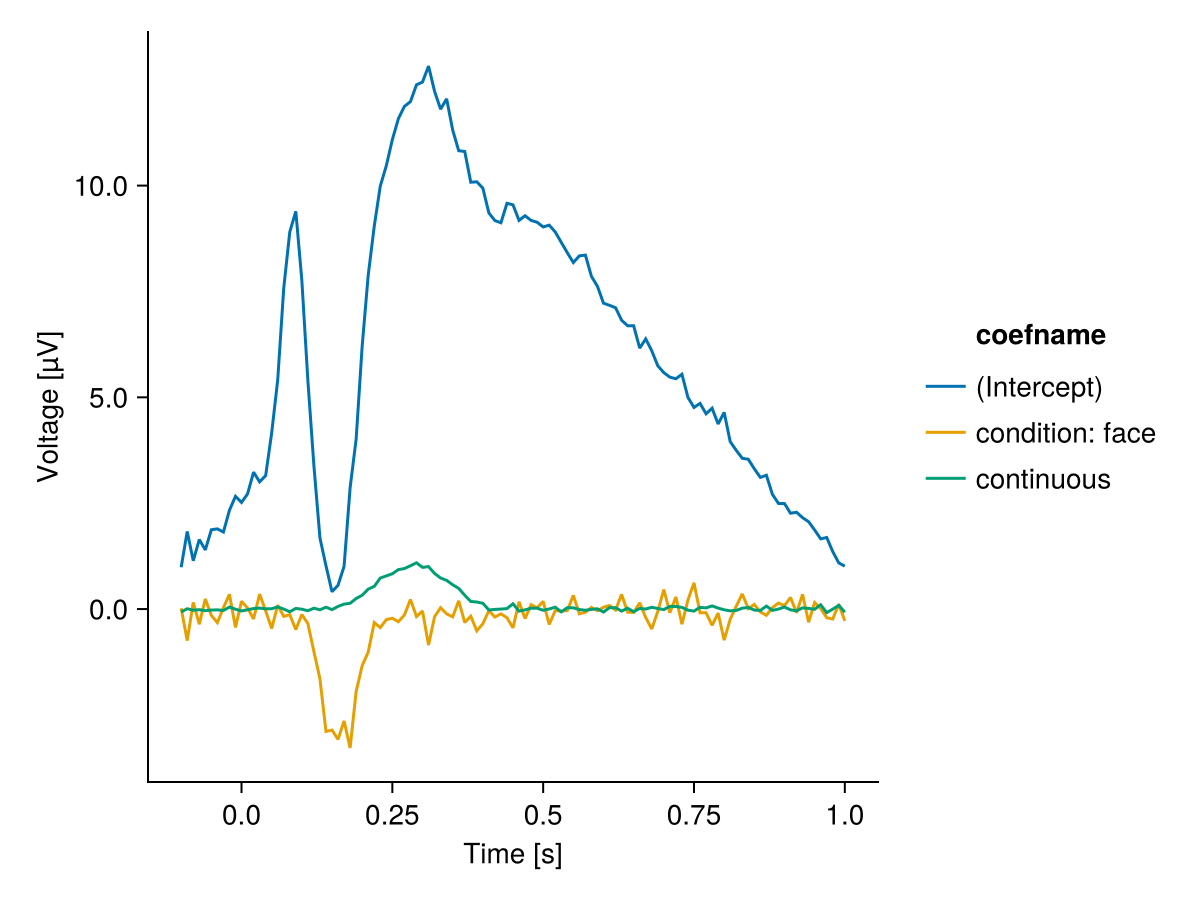
Fitting the Overlap-corrected LDA model
Following the MLJ Modelzoo we have to do the following to load an LDA model
using MLJ, MultivariateStats, MLJMultivariateStatsInterface
LDA = @load LDA pkg = MultivariateStats
uf_lda =
    Unfold.fit(UnfoldDecodingModel, des, evt, dat, LDA(), Any => :condition; nfolds = 2) # 2 folds to speed up computation
plot_erp(coeftable(uf_lda); mapping = (; color = :coefname))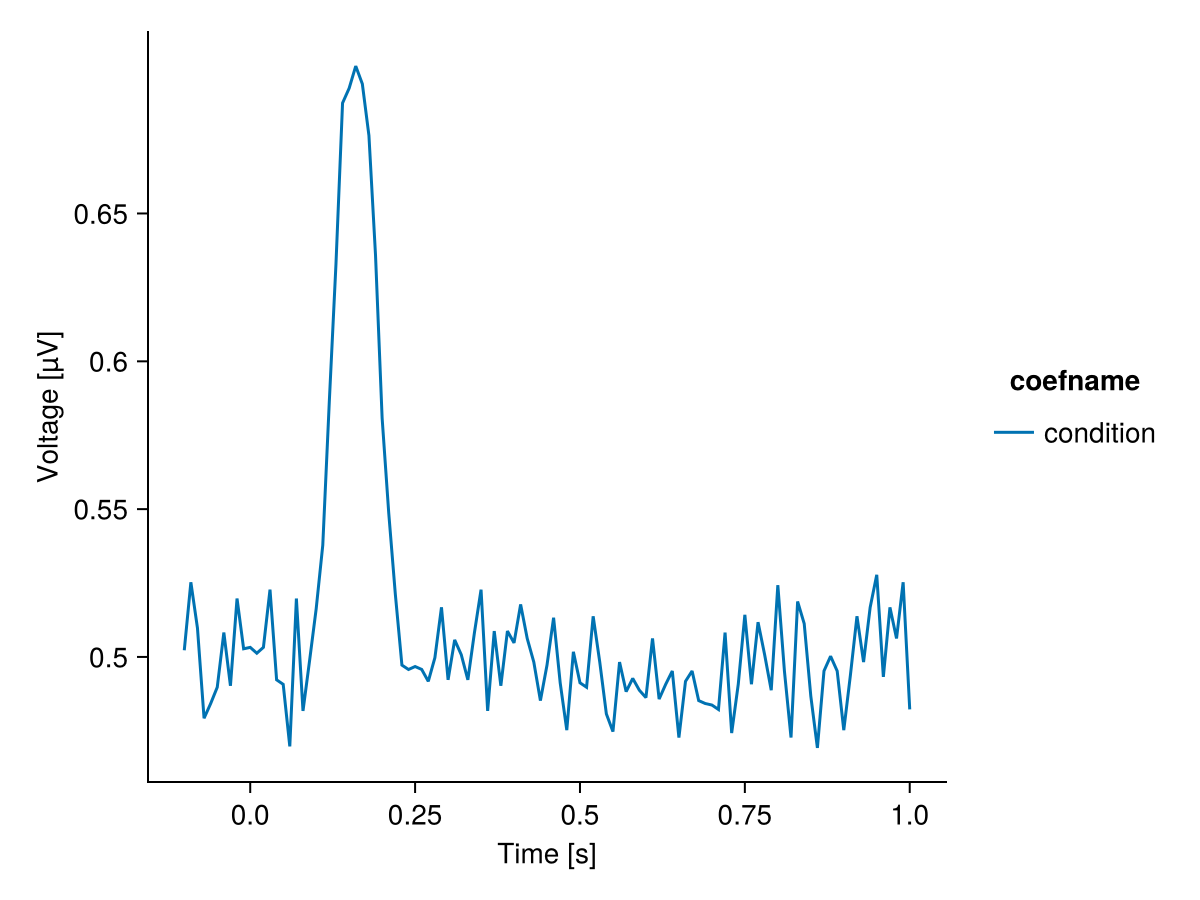
Voila, the model classified the correct period.
This page was generated using Literate.jl.